 Safaris
Bergsteigen
Wandern
Inselwandern Weltweit
Safaris
Bergsteigen
Wandern
Inselwandern Weltweit
 Chronologie
Inselwandern
Chronologie
Inselwandern Europa
Inselwandern
Europa
Inselwandern
 Städtewandern
 Paintings
 Dirk Rauschenbach

 Mail ccooly(
at) web.de
Mail ccooly(
at) web.de|
Safaris
Bergsteigen
Wandern
Inselwandern Weltweit
|
Chronologie
Inselwandern |
Europa
Inselwandern
|
Städtewandern
|
Paintings |
Dirk Rauschenbach
|
Mail ccooly(
at) web.de |
zurück Irland Boat of Lord Brendan´ s Boot Der aller erste Amerikaentdecker
Craggaunowen Project
Excellent choice! The Craggaunowen Project is one of Ireland's
most fascinating and unique heritage sites. It's often called "The
Living Past" because it goes beyond static exhibits to actively
demonstrate how people lived in ancient Ireland. Here’s a comprehensive
overview of what the Craggaunowen Project is all about: Core Concept
Craggaunowen is an open-air museum located on a 50-acre wooded estate
in County Clare. Its mission is to recreate and showcase Ireland's life
from the Mesolithic (Middle Stone Age) period to the late 16th century.
It’s an experiential archaeology project where visitors can see, touch,
and understand ancient technologies and dwellings. Key Attractions and
Features The Crannóg This is a faithful reconstruction of a Celtic-era
artificial island settlement (circa 500 AD), built on a natural lake on
the estate. Accessible by a wooden causeway, it features a circular
dwelling with a thatched roof, where interpreters demonstrate daily
tasks like grinding grain, weaving, and tool-making. The Ringfort
(Ráth) A reconstruction of a typical defended farmstead from the Early
Christian period (c. 400-1000 AD). It consists of a circular bank,
ditch, and palisade enclosing a clan chief's house and souterrain
(underground storage/escape passage). The Bronze Age Cooking Site A
simple but effective display showing how food was prepared using
fulacht fiadh (burnt mounds) – a common Bronze Age method of cooking
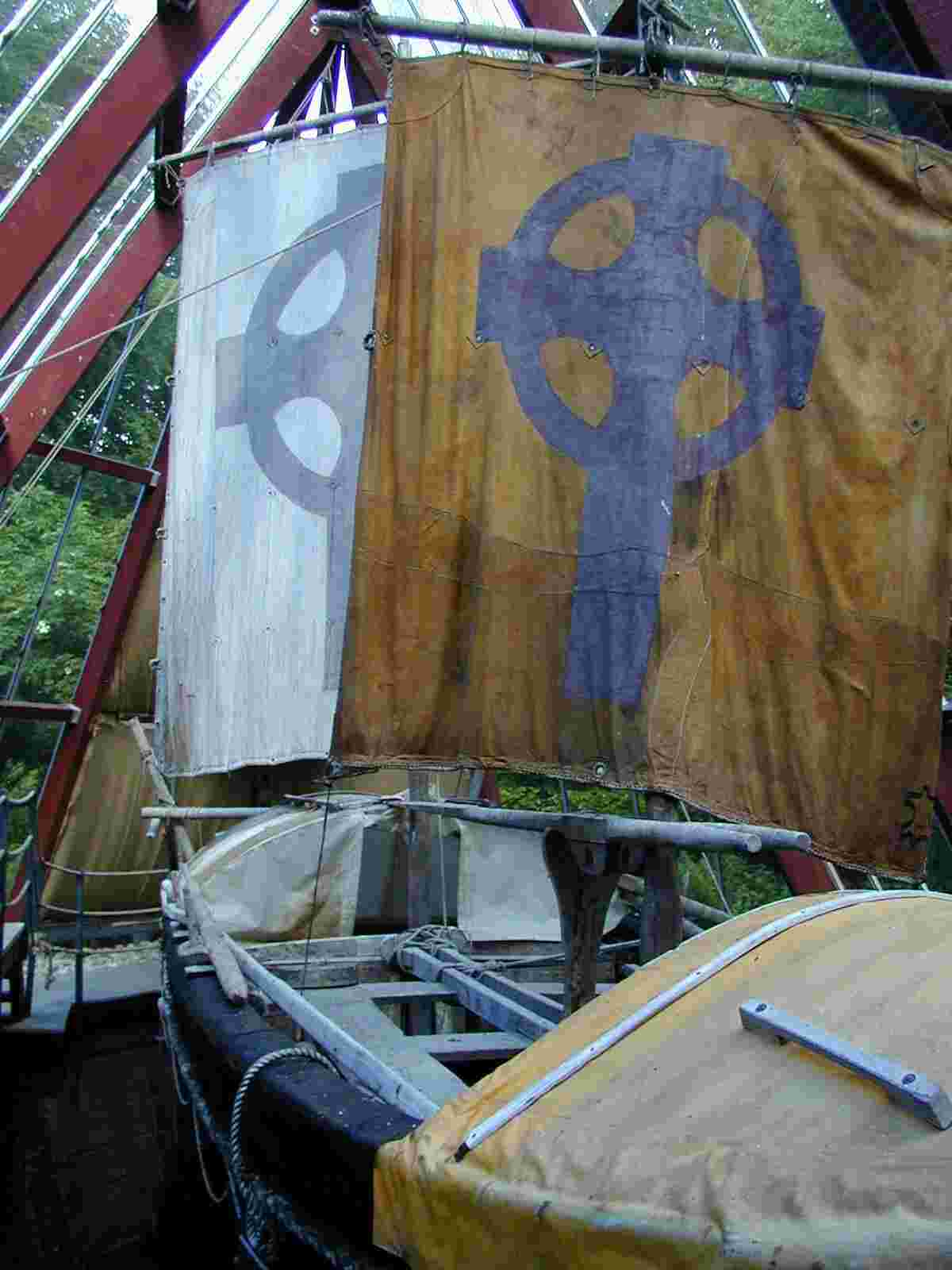
with heated stones in a wooden trough. The "Brendan Boat" (St.
Brendan's Navigational Project) This is one of the project's most
famous exhibits. It houses "Brendan," the iconic leather-hulled curragh
in which explorer Tim Severin sailed across the Atlantic in 1976-77.
Severin's voyage aimed to test the medieval legend of St. Brendan the
Navigator, who supposedly sailed to North America in the 6th century.
The successful voyage proved the legend was technologically possible.
The boat is displayed in a specially designed glass enclosure. The
Castle The 16th-century Tower House around which the project is built.
It's a fine example of a later medieval Gaelic stronghold and provides
historical context for the end of the timeline the project covers.
Ancient Roadways (Toghers) The estate features preserved sections of
ancient bog roads—wooden trackways built across wetlands, the oldest
dating back over 5,000 years. Founder & Vision The project was the
brainchild of John Hunt, a noted antiquarian, art collector, and former
curator of the National Museum of Ireland's antiquities. In the 1960s
and 70s, he transformed the Craggaunowen estate into an experimental
archaeology center. His vision was to create a place where Ireland's
distant past could be physically experienced, not just read about.
Visitor Experience Interactive & Educational: Costumed guides often
perform demonstrations of ancient crafts like felting, bronze casting,
and woodworking. Natural Setting: The woodland walks and lakeside
location make it a beautiful spot to explore, blending nature and
history. Appeal: It's hugely popular with families, school groups,
tourists, and anyone interested in archaeology, history, or sustainable
living. Practical Information Location: Near Kilmurry, County Clare,
about a 20-minute drive from Limerick City or Shannon Airport.
Management: The project is now managed by Shannon Heritage, which
operates several key tourist sites in the region. Best Time to Visit:
Open seasonally (typically April to September). Check the official
website for current hours and events. Why It's Significant Craggaunowen
was a pioneer in experimental archaeology in Ireland. It moved beyond
glass cases and allowed people to step into reconstructions based on
rigorous archaeological evidence. It makes the past tangible and asks
visitors to consider the ingenuity and skills of our ancestors. In
short, the Craggaunowen Project is not just a museum; it's a time
machine that offers a hands-on, immersive journey through 5,000 years
of Irish history and prehistory.
 05.06.26 Copyright Dirk
Rauschenbach Koelnerstrasse 293 51702 Bergneustadt
Datenschutzerklaerung 02261 94417 oder
Handy oder Mail ccooly(
at) web.de
05.06.26 Copyright Dirk
Rauschenbach Koelnerstrasse 293 51702 Bergneustadt
Datenschutzerklaerung 02261 94417 oder
Handy oder Mail ccooly(
at) web.de